Geek News: Latest Technology, Product Reviews, Gadgets and Tech Podcast News for Geeks


Tag: cloud

Copy: Cloud Storage for All Your Files

Posted by KL Tech Muse at 5:49 PM on May 17, 2013

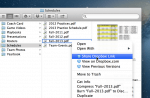
CopyCopy a competitor to Dropbox became available to the public today. It allows you to upload your files to the Barracuda Network cloud, where you can access them from any device that you have installed the Copy application on. It will work on most platforms including Macs, Windows, Linux, iOs and Android. According to their press release Windows Mobile is coming soon. Files can either be shared publicly or privately thru an invite. The person sharing the files controls what the person receiving the shared file can do with them, whether they can just view them or actually edit to the files.

Currently you receive fifteen GB of free storage by signing up and another five GB when you down load a desktop version of the application. You can also get another two GB by sharing on Twitter. For $9.99/month or $14.99 a month you can buy two hundred and fifty GB or five hundred GB of cloud storage. They also have options specifically created for businesses. You can upload any type of file you want, text, audio and even 1080 videos. You simply drag the file or folder into the Copy of Folder or any of it’s subfolders you create. On my iPad and Android phone Copy organizes your recently modified files into different categories, so you can view just image files,  just text files or just video files. If you share a file publicly from Copy and it is in violation of the DCMA, Barracuda Network will respond to any DCMA takedown.

On an Android device I was able to upload any file, however on the iPad I could only upload images . I expect this was because of Apple’s sandboxing policy. I was able to upload a text file from the application Draft by using the open with option. Other applications do not have this option and they will have to allow Copy to have access to them like they do Dropbox. Copy does have API documentation available for developer who want to build applications that integrate with the Copy platform, it is currently in beta. Another problem is the only way to lockdown Copy is to log out of the account. There needs to be a pin to lock it down without having to log out. This addition would be especially important if Copy is to be used to store sensitive information.  Despite these complaints I do recommend trying Copy, especially if you are looking for some more free cloud storage.


Polkast Personal Cloud Service

Posted by KL Tech Muse at 10:10 AM on February 19, 2013

Polkast Polkast allows any individual to create their own personal cloud server quickly and easily. This would allow them to access the date including documents, photos, videos and music that is on their home computer from anywhere in the world where a connection is available. Polkast allows the user to stream video from their home computer to their mobile device, because it doesn’t have to go thru the cloud and the connection is direct you get a better streaming quality. However the quality of the stream is effected by your local bandwidth. Polkast has recently added the Aviary Photo Editing system to its cloud app. This will allow you to editing any photo that is on your home computer on your mobile device.

Polkast is free to use on one computer. There is a pro version which will allow you to connect to multiple computer. This version is available for Windows only and there is a $4.99 a monthly subscription fee. The pro version also you enables you to connect PC to PC. The Polkast Music service allows you to seamlessly integrates your iTunes collection to your mobile device . Play any song, no need to sync or download. You can create a playlist on the go and even listen off-line. Polkast Music is $4.99

Interview by Todd Cochrane of Geek News Central for the TechPodcast Network, andInterview by Don Baine, the Gadget Professor.

Sponsored by:
On new orders get 35% Off your GoDaddy Order use Promo Code:go35off2
GoDaddy Promo Codes always save you money, check out my Promo Codes Today

PlayPlay

Pogoplug Mobile Review

Posted by Andrew at 12:50 AM on October 25, 2012

Pogoplug LogoThe cloud is definitely where it’s at right now, but what if you don’t like the idea the idea of Google, Dropbox et al looking after your data? Then you might be interested in a Pogoplug, which allows you to create your own cloud storage that’s only limited by the size of the hard disk. A Pogoplug is a hardware gadget that connects USB storage devices to your local LAN and then makes the space available across the Internet, effectively creating a personal cloud. The data is stored in your control and if more storage is needed, plug-in a bigger hard drive.

On review here is the Pogoplug Mobile, the 3rd generation of Pogoplug device from Cloud Engines. It offers a single USB port plus an SD card slot along with the network port and power socket. Newer Pogoplugs come with USB3 ports, but as the maximum speed of the Pogoplug cloud is always going to be the speed of the Internet connection, the faster transfer speeds of USB3 are unlikely to be a significant benefit. For testing, I used a 64 GB memory stick, rather than a hard drive, which means that the unit will run silently with minimal power consumption.

Pogoplug Packaging

The Pogoplug website has downloads for Windows, Macs and Linux, and the relevant app stores have versions for Android, iOS, Blackberry and legendary WebOS. I was able to try the Windows, Linux, Android and WebOS versions. The Windows version connects to the Pogoplug and presents it as a drive letter, allowing most Windows applications to use the Pogoplug transparently. The Pogoplug software has additional backup functionality as well, which may be useful for some people. The Linux version is command line only but anyone familiar with Linux will have no trouble getting the Pogoplug mounted into the filesystem.

The Android app is simple and straightforward with a couple of nice tricks up its sleeve. Broadly you can browse files in a directory fashion or you can view music, photos and movies in a tag or meta-data based fashion, As expected, there are viewers and players for the media, though movies get handed over to the default app rather than playing within the Pogoplug app. The music player is basic and has one really irritating flaw; it doesn’t seem to be able to pick up the track number from the mp3 files and consequently orders tracks alphabetically when playing albums. This really needs to be fixed.

Back viewPerformance-wise, the Pogoplug is always going to be limited by the upload (rather than download) speed of the broadband connection when outside of the home. This usually meant a little bit of buffering before playing music but once the playback got underway, there was rarely any stuttering. There were occasional times when folders refused to refresh but my suspicion is that any problems were down to the local data connection on my phone rather than a problem with the Pogoplug. YMMV. Inside my home, the performance was excellent.

In common with other social and cloud apps, the Pogoplug app has automatic uploading of pictures and video from the devices camera. It’s also possible to set the folder where the uploaded images are to go. Frankly, this is brilliant as my wife is hopeless at remembering to copy photos off her smartphone so by setting up the Pogoplug app on her phone, any photos she takes get automatically transferred. On occasion, a photo would sometimes fail to completely upload; again I suspect the loss of 3G connectivity than any fundamental problem, but the error checking could be improved. It’s also possible to upload any image from within the photo Gallery app.

As with most cloud solutions, you can also share with friends and family, using either the app or the web interface. It’s straightforward – select the folder you want to share, select who you want to share with and an email is sent to them with the relevant link. It’s an easy way to share photos of Junior with grandma and grandpa.

Any downsides? Only two that i can see….first, there’s no direct integration with any other apps that I could find. Quickoffice and other office apps typically allow access straight into Google Drive or Dropbox but none seemed to work with a Pogoplug. Effectively I had to download a Word doc to the phone, do my edits in QuickOffice and then upload the doc back to the Pogoplug. Not slick.

The second is that when I was at home and on the same subnet as the Pogoplug, Internet access to Pogoplug’s servers was still needed, presumably to check authorisation privileges. Normally, it’s not going to be an issue, but it would be handy to have a way to bypass this when working locally and the connection to the Internet goes down.

Overall, the Pogoplug is a handy device that gives you control over your data rather than entrusting it to a megacorp. A few glitches spoil what is otherwise a neat little solution that potentially gives as much data storage space as you need, without paying per GB per annum. For the low cost of the Pogoplug unit (about $50 / £35), it’s a bargain.

Disclaimer – this was a personally purchased device.

Do We Still Need to Own Music?

Posted by Alan Buckingham at 9:38 AM on October 19, 2012

I own a lot of music.  Well, the real truth is that it’s mine and that of my wife and kids, but all told it adds up to just over 95 GB.  The music collection started off with albums and cassettes when I was a kid, but later on those were all replaced by CD, and I traded in the albums, with the exception of a few rare bootlegs and imports that are sitting in a storage room collecting dust.  Later still, the CD’s were ripped to MP3 and also traded in and, since then, all purchases of music have been of the digital persuasion.  Time, and formats, march on.

Today all of our music resides on an external hard drive hooked to a home theater PC and backed up by CrashPlan and Google Music.  I use an Android smartphone as my MP3 Player, but it doesn’t actually have any music stored on it.  Every song we own can be streamed by the Google Music player but, the truth is, I almost never use it.  I work from home and I listen to something almost continuously but, the music we own just isn’t a part of my day because it just doesn’t command the importance it did before the digital era.

These days I listen to a lot of podcasts and, for that, I use Beyond Pod, but I also still listen to a lot of music.  I pay for a subscription to Pandora One and I have used many of my favorite artists to create stations so that I don’t need to scroll through that massive collection to find them – they just pop up and play, along with the music of other related artists.  It’s better this way.  Sure, I still bookmark a really good song thinking maybe I will buy it later, but honestly…I don’t.

Every once in a while the mood strikes me to hear a particular song but, for that, there are an untold number of sources, including Spotify, Grooveshark, YouTube, etc.  There are many others, but those three alone can provide almost any song you can imagine, even the most obscure tunes from your youth are there.

So, the question is, do we really still need to own music?  With the ability to play almost anything, anytime and create streaming stations that are tailored to our tastes, do we still have the need to buy songs, even in a digital format?  I may still be in the minority, but my answer is a resounding no.  The world is moving on and there are now better, more efficient ways.

Image: Player of Vinyl Disks by BigStock

Protecting Your Digital Assets

Posted by JaimeDavis at 9:03 AM on August 8, 2012

Two FactorMat Honan’s story (as covered by Todd in the latest podcast) showed me that the strongest password in the world is worth nothing if it can be reset by a straightforward social engineering-based attack. I’m sure Apple and Amazon will be looking hard at their policies and procedures but for the individual, there’s also much to learn from the episode.

i) Two-factor authentication. There’s no doubt that this is a good thing and I enabled it on my Gmail account last night. Turning it on is easy, but it’s a pain in the ass for the first few hours as you re-login to all your Google-based services. With several regularly used PCs, email clients and umpteen mobile devices, it takes a bit of time to get them all setup correctly. Touch wood, now that I’ve been through the re-login process, things are largely back to normal.

ii) Backup, backup, backup. For at least part of the story, Mat is entirely to blame. If there’s only one copy of any piece of data, it might as well not exist. Never mind hackers; theft, damage and accidental deletion make it all too easy to lose data, especially with mobile devices. Disk space is cheap, so even if you have just one PC, have a working set of folders, a backup set of folders and also make copies on a regular basis to a USB drive, which you disconnect from your PC when not in use and preferably store somewhere else.

iii) It’s your data. Convenient as “the cloud” is, remember it’s your data and your responsibility to keep it safe. If you push information directly to the cloud, don’t forget to include this information in your backup routine. Google has tools to download data from its services. Or don’t bother with someone else’s cloud and build your own, using a PogoPlug or similar.

iv) Download email using POP3. I use web-based Gmail and IMAP-enabled apps to manage my email and if email is deleted from Gmail…poof, it’s all gone. By using a POP3 email client like Thunderbird, you can have a copy on your PC as well.

v) Spread the load. Convenient as it might be to have all your eggs in one basket, either with Apple or Google, consider spreading your digital assets across different services, e.g. email on Gmail, work files on Dropbox, personal files on Box, photos on Flickr. If someone does compromise one of your accounts, all is not lost in one go. But don’t use the same password across all the systems.

vi) Remote kill-switch. The ability to kill mobile devices remotely is very handy if they are stolen but there’s a risk that the kill-switch can get into the wrong hands as in this case. However, the benefits probably outweigh the risks in that you are far more likely to lose your device than be hacked, so it’s perhaps better to focus on minimising the fall-out from both physical loss and a remote wipe.

There’s certainly plenty of food for thought there and even if you only take on one or two of the suggestions above, you’ll make yourself much harder to attack while lessening the impact.

Picture courtesy of Brian Ronald.

Jolicloud Launches Public Profiles

Posted by Alan Buckingham at 4:41 PM on June 13, 2012

Cloud storage hub Jolicloud today announced the launch of their new Public Profiles for users.  If you aren’t familiar with Jolicloud, it’s a service that grabs all of your various data from different social services like Twitter, Facebook, Instagram, Flickr, Picasa, and Tumblr and places the data into neat files in one single location that users can then easily scan.  For instance, you’ll find all of the photos you posted on different networks all grouped together in a convenient Photos folder.  The same for music, links, videos, and documents.

The new Public Profiles allows users to more easily share content with friends straight from Jolicloud.  Users can invite and follow friends and give them access to your media stored there.  Jolicloud only shares the data users have made public.  The new update is for both the web and iOS versions, but they hinted that Android would be coming next week, possibly with even more features.  Their official annoucement stated, “We’ve heard a lot of feedback about Jolicloud over the last few weeks, and now we’ve decided to bring some of the most requested features to you with an update to our iPhone and web apps.”  They went on to hint that, “Rumors among robots mention a major event for next week.  But you know, those are only rumors..”

Jolicloud is still officially in beta, but the service is stable and so far seems secure.  It’s also free to use, and there are mobile apps for both iOS and Android.  You can get a view of the main screen below.

AKiTiO MyCloud Mini Review

Posted by geeknews at 10:28 PM on May 8, 2012

Over the past couple of weeks I have had a AKiTiO MyCloud mini plugged into my network, and when I say mini its small but packs an amazing punch. The AKiTiO MyCloud Mini is essentially a mini customized Linux server that surprisingly has a lot of standard Linux server features, that can become it’s own NAS device which then can be used as a file server. It is made to serve up media, documents, images files locally or remotely.

Managing the tiny device is done so though a web browser which is served from the device itself. My son who is 15 became quite enamored with it, and I let him manage it. The first thing he did was attach an external eSata drive that I let him borrow, and started pulling in video clips to the device that he subsequently accessed via his Xbox 360.

The MyCloud Mini supports streaming to media devices that supports UPNP and DNLA, like the Xbox 360, iTunes, Windows 7 and a variety of other devices.

I think my son became the geek of the week, when he showed his buddies at school his remote file server and how he could access files on it from his mobile phone.  There is an associated Android and iPhone app for the device which makes it easy to access your content while remote.

My concern was security and I ran a variety of test against the device internally and externally and could not find any reason to be concerned about placing media and files on the device to be accessed remotely.

What surprised me was how quickly my son got the hang of managing it. I did have to explain some very basic things to him like how he could manage it with a web browser. For the price which runs close to a $100.00 a small business or home owner could use this device to manage there media.  I never know whats going to be shipped to me to review and form the get go I knew the team that designed put a lot of thought into the design and management of the device.

I have only touched the surface of what this server can do and amazed what it does at the price point. For more info visit AKiTiO.com for more details.

Polkcast Creates Your Personal Cloud

Posted by Andrew at 9:00 PM on February 24, 2012

Polkast LaptopPolkast thinks that it’s better to have your files in your control in your home or office rather than the nebulous cloud. Andy talks to Dave from Polkast on how they do this but still give you access from your smartphone.

Polkast consists of two components, a server app that’s installed on the PC or Mac where all the documents and files are stored. A client app goes on your smartphone or tablet, and both iOS and Android devices are supported, including the Kindle Fire.

The client app is much like any media player interface with icons for music, photos, videos, documents and so on. You can browse for the media you want and show photos or play music.

For a single PC or Mac, Polkast offer a free service, no matter how many client devices connect. For multiple PCs or Macs, the premium service costs $4.99 per month (though this option doesn’t seem to be available on the website yet).

Interview by Andy McCaskey of SDR News and RV News Net.

Sponsored by:
On new orders get 35% Off your GoDaddy Order use Promo Code:go35off2
GoDaddy Promo Codes always save you money, check out my Promo Codes Today

PlayPlay

Dolly Drive Cloud Backup for Time Machine

Posted by Andrew at 8:55 AM on February 17, 2012

Dolly Drive Time Machine Cloud DriveApple’s Time Machine has been a lifesaver for many people, especially when they’ve accidentally deleted an important file. However, it doesn’t protect against fire, flood or theft when everything is lost. Enter Dolly Drive, a Time Machine-compatible cloud-based backup service.

Available as a subscription service based on data usage, Dolly Drive looks like another Time Machine target to OS X and once setup, will store revisions and changes to the cloud, giving the security of off-site backup.

Included as part of the deal, subscribers are sent a hard drive via courier to return and seed their Dolly Drive for the first time. This avoids a lengthy upload over broadband when the service is first started and the whole disk is copied.

Prices start at $5 per month for 50 GB but a more representative subscription is $10 pcm for 250 GB. As a bonus, 5 GB is added each month for free.

Interview by Andy McCaskey and Courtney Wallin of SDR News and RV News Net.

Sponsored by:
On new orders get 35% Off your GoDaddy Order use Promo Code:go35off2
GoDaddy Promo Codes always save you money, check out my Promo Codes Today

PlayPlay

my-Ditto Key

Posted by KL Tech Muse at 4:29 PM on January 22, 2012

my-Ditto Key Do you put data on a USB stick and then do you tend to lose that USB stick? Do your kids store their homework on a USB stick and then lose it? I sure for most people the answer is yes to all of the above. Let’s face it we’ve all done it; we’ve put data on a USB stick that we want to bring with us, then we put it down somewhere or leave it behind. That use to mean that not only was the USB stick was gone but all the data on it. No longer now the information on the USB stick can also be in the cloud.

That is the idea behind my-Ditto Key. You register your my-Ditto Key with my-Ditto and then all the information on the key is copied to the cloud. Now if you lose your my-Ditto Key USB stick or leave it behind you still have access to your data anywhere in the world. You can store up to 100 GB of space in the cloud. It doesn’t matter what type of data it is it can be music, videos, documents it’s up to you. Simple and easy to use, but effective that is what my-Ditto key is all about.

Interview by Todd Cochrane of Geek News Central

Sponsored by:
On new orders get 35% Off your GoDaddy Order use Promo Code:go35off2
GoDaddy Promo Codes always save you money, check out my Promo Codes Today

PlayPlay